26 visual study sheets Companion to the Study Monograph v1.3 / September 2026
Not a crowd of agents. An institution that can remember, authorize, and answer for its
work.
A condensed map of the book's concepts for returning readers: recover
a distinction, choose a mechanism, or locate a question worth testing.
These sheets summarize the argument; they do not replace its evidence,
assumptions, or detailed examples.
PurposeWhat result is worth pursuing?
defines
Roles & dutiesWho owes what, to whom?
organizes
Coordinated workWhich contributions depend on others?
attempts
Consequential actionWhat changes outside the conversation?
Before the effect
Authority
Scope · policy · capability Actor · expiry · revocation
Can this actor perform this act, here, now? constrains action
Curated and written by AI Under the direction of
Dr. Paulo SalemResearch cutoff: 20 September 2026 Editorial synthesis; not a
new empirical study.
Artificial OrganizationsOrganizing work / 02
Why organize at all?
Make limited attention go further.
Conserve expertise without losing the grounds for judgment.
Decide under limits
Bounded rationality
Evaluate choice against available information, capability, time
and resources, not an imaginary omniscient optimizer.
Satisficing
Stop at an explicit acceptability threshold. Reaching it does
not prove global optimality or that the threshold is adequate.
Uncertainty absorption
Recipients see an inference instead of its observations.
Efficient, but tentative judgment can harden into apparent fact.
Loss-accounted compression
The book's heuristic: preserve paths to evidence, omissions and
dissent while reducing reading effort.
Conserve expertise
Information need / capacity
Reduce coordination demand through boundaries or slack; increase
capacity through systems and lateral relations.
Knowledge hierarchies
Keep routine problems with general workers; send rare exceptions
to experts. Task distributions and costs decide the benefit.
Firm boundary
Compare the next activity inside, outside, or in another firm.
Include search, bargaining, adaptation and internal
administration.
Who gets through? Sequential veto screens reject
more bad and good proposals; independent acceptance
channels admit more of both under the compared assumptions. More
reviewers is not neutral.
Whose objective? Participants may disagree about
goals as well as facts. A joint plan needs legitimate decisions
about tradeoffs; more information alone cannot settle competing
claims.
Two responses to information pressure
Reduce the need: choose workable boundaries, predictable
interfaces and appropriate slack. Increase capacity: use
information systems and lateral relationships. More reports can add
workload without improving either.
Foundations: Simon; March & Simon; Cyert & March; Galbraith;
Thompson; Mintzberg; Garicano; Sah & Stiglitz; Coase; Williamson.
Dechter (1999); Stone & Veloso (2000); Guestrin et al. (2001); Q.
Wang et al. (2024); Kim et al. (2026, v3). Mechanisms and comparisons:
book §§4.2–4.8.
Artificial OrganizationsOrganizing work / 03
The boundary is a design decision
Separate the work. Keep the dependencies.
A smaller assignment is useful only if its result still fits the
whole.
Factorization
Find components whose contributions can be solved or assessed
separately, then retain the interactions needed to combine them. A
single controller can exploit the same structure.
Near-decomposability
Interactions are stronger within units than between them. Weaker
coupling makes a boundary useful; it does not make that boundary
irrelevant.
ReciprocalWork changes other inputsMutual adjustment
What is standardized? Process, output and skill give
different assurances. Supervision and mutual adjustment solve other
coordination problems. A title does not certify skill; compliance does
not establish an outcome.
A decomposition test
Change one unit's output, timing or resource demand. Which other
units must respond? If the answer is hidden, the diagram is
simplifying the wrong thing.
Watchmakers: stable intermediate assemblies preserve work
through interruption. Paint factory: staffing, production and
inventory still need joint planning.
Bottlenecks survive sparse graphs. One critical shared resource
can dominate elapsed time. Test contention and integration costs
alongside message counts; fewer connections do not guarantee fast
coordination.
Simon (1962); Thompson (1967); Mintzberg (1979); Dechter (1999);
Guestrin, Koller & Parr (2001). Diagram: editorial synthesis; no
universal computational speedup is claimed.
Artificial OrganizationsEvidence & judgment / 04
Three cases / capacity, search and review
What does separation actually buy?
Physical capacity, focused search and fresh review solve different
constraints.
Kiva / moving stock
Insight. Parallel robot deliveries and shared navigation
corrections bring shelving to human pickers; a single robot cannot
be in several places at once.
Insight. Anthropic reports its team found S&P 500
technology companies' board members where one Opus 4 agent's slow,
sequential searches failed.
Hadfield et al. (2025): vendor-reported result, not an equal-cost
comparison.
Separate histories keep each search focused; summaries support
integration. A single controller can also manage isolated contexts.
The report does not isolate separation from extra compute; the
diagram is schematic.
Research example / Wu et al. · 2023
OptiGuide / separate writing from checking
Insight. Separating the writer and checker improved
unsafe-program detection within each tested model family, without
adding a more knowledgeable model.
The demonstration. A coffee analyst asks about a 5% rise in
roasting costs. A Writer changes the optimization program, a
Safeguard screens it, and a Commander manages solver execution:
optimal total cost rises from 2470 to 2526.5.
The separate experiment. Across 100 constructed tasks, half
safe and half unsafe, separated writing and checking improved F1
against one agent doing both, with GPT-4 and GPT-3.5-turbo.
Equal access is not equal attention. A single controller can
also provide a fresh review context. This study does not establish
matched-cost superiority over that controller, identical
operating-system permissions, or guaranteed safety. The coffee
example is a demonstration, not a factory deployment.
Time, not just throughput
Separate workers can reduce elapsed time only for parallelizable
work. Shared tools, serialized dependencies and integration can
remain the bottleneck.
Error independence
Several reviewers can repeat the same mistaken premise. Test
against outside evidence; agreement alone does not establish
independent confirmation.
Wurman, D'Andrea & Mountz (2008); D'Andrea retrospective; Hadfield
et al. (2025), Anthropic account; Wu et al., AutoGen (2023, v2), §3
A4, Appendix D A4, Tables 13 and 15. Full evidence limits: book
§§4.2–4.3, 4.8, 6.1 and 10.7. No new agent or solver run for this
guide.
Artificial OrganizationsOrganizing work / 05
Case study / Paint factory
Holt, Modigliani, Muth & Simon · 1960
A local saving can raise the total cost.
Insight. The paint-factory model connects staffing, production
and inventory because a cheaper choice in one activity can create
greater costs elsewhere.
Orders change; hiring and layoffs are costly; overtime and
stockholding are costly too. The anonymous company studied by the
researchers had to choose a plan across these pressures, not optimize
each department in isolation.
Tempting local choice
Consequence elsewhere
Joint question
Keep fewer workers
A demand increase may require overtime, hiring or delayed
orders.
What capacity will later commitments need?
Keep output steady
Low demand accumulates stock; high demand can exhaust it.
Which adjustment and inventory costs are acceptable?
Minimize stored stock
Less buffer remains when orders exceed immediate production.
What service loss follows a shortage?
What was studied
Six years of production and workforce decisions, modeled through
retrospective simulation. The original forecasts were unavailable,
so forecast assumptions materially affected the comparison.
What it teaches
Preserve cross-unit and cross-time consequences. A central planner
or a coordinated team can do this; three locally optimized agents
do not automatically produce a good joint plan.
Holt et al., Planning Production, Inventories, and Work Force (1960),
ch. 1, pp. 16–25. Diagram and choice table: explanatory reductions,
not measured effects of hypothetical interventions. Book §4.5 gives
the source and forecast limits.
Artificial OrganizationsAuthority & risk / 06
Case study / TVA
Philip Selznick · 1949
Local reach brings local influence.
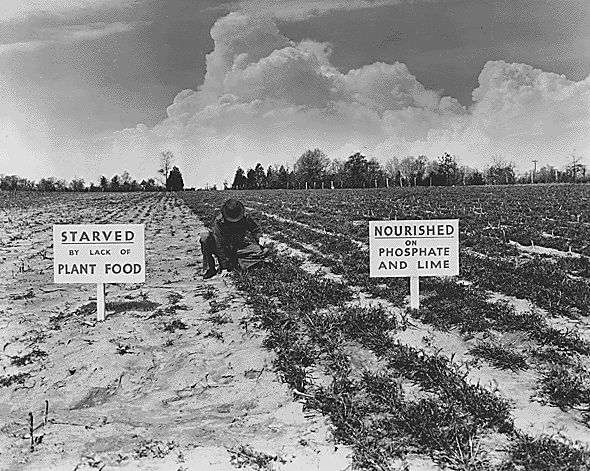
Insight. The partnerships that gave TVA access to farmers also
gave intermediaries influence over which farmers and interests the
public programme served.
Results of Fertilizer, 1942. FDR Presidential Library,
27-0921a; public domain. Test plots illustrate inspectable field
work, not proof of representative participation.
Image source and rights.
Capacity gained
Land-grant and extension partners supplied local knowledge, access
to farmers, demonstration sites, records and visits.
Influence admitted
Intermediaries helped select participants and the evidence
returned. Cooptation secured cooperation while creating
commitments beyond the formal mission.
For agent organizations: investigate how providers shape
visible requests and evidence. This is a design question, not an
equivalence with TVA's history.
Participation was work
Demonstration farmers changed farm plans, kept records and check
plots, paid freight and allowed visits. They produced and
communicated evidence, rather than merely receiving it.
Two separate claims
Visible crop differences concern a treatment claim. Selection by
extension officials, committees and meetings concerns whose
interests enter the programme. One does not establish the other.
Selznick, TVA and the Grass Roots (1949), chs. III–IV, especially pp.
130–132. Historical field research on the agricultural programme; not
a description of all TVA activity or its present organization. Full
source route: book §4.5.
Artificial OrganizationsAuthority & risk / 07
Case study / Coal supply
Paul L. Joskow · 1985
Buy, contract, or bring inside?
Insight. Greater dependence between a mine and a power plant
can make safeguarded long-term supply or common ownership more
valuable than repeated market purchases.
01
Market purchase
Clear output, checkable quality and credible alternative suppliers
or buyers.
Still pay for search, verification and switching.
02
Long-term contract
Protect relationship-specific investment while retaining separate
ownership and supplier incentives.
Still negotiate changes and handle gaps.
03
Common ownership
Use administrative coordination where frequent, unforeseen joint
adjustments are costly to bargain over.
Still face weaker incentives, internal conflict and managerial
error.
Navajo Mine to Four Corners, 1972. Lyntha Scott Eiler,
EPA/DOCUMERICA, NARA 544169; public domain. The supply connection
is visible; these firms are not identified as Joskow's sample.
Image source and rights.
Asset specificity
An investment loses value outside the relationship; weak
alternatives create a hold-up risk.
Residual control
Ownership allocates decisions contracts leave unspecified. It can
improve one party's incentives and weaken another's.
Integrate only when easier adaptation outweighs administrative and
incentive costs. A long-term contract may be better; proximity is
insufficient.
Joskow (1985), with Coase (1937), Williamson (1979) and Grossman &
Hart (1986). Book §4.7.
Artificial OrganizationsOrganizing work / 08
Responsibility survives replacement
The worker changes. The duty remains.
Model the position, its occupant, and its obligations separately.
EphemeralActor Aenacts until t1
replace occupanttransfer unfinished work and access
EphemeralActor Benacts from t1
Same role; separate recorded intervals
Durable institutional position
ROLE
Group scope · permitted occupants · compatibility · version
Authority linkWho may direct or monitor?
MissionWhich goal bundle is assigned?
Deontic relationWhich duty or permission binds?
Four questions before dispatch
Scope. In which group does this position apply? A role
name is not a global credential.
Occupancy. Who enacted it when the act occurred? Preserve
intervals and actor identity.
Compatibility. May the proposer also be the reviewer?
Separate real constraints from bureaucratic habit.
Continuity. What pending commitments, credentials and
attempts remain when the worker changes?
Landmarks, not one compulsory path
A landmark specifies a required state: for example,
recovery evidence accepted. Several procedures
may reach it.
That flexibility changes the route, not the duty, permissible
means, or acceptance standard. A new plan must not quietly
redefine what counts as success.
Replacement is a transition, not a rename. Test it during
unfinished work, not only while idle.
Organizational, normative, ontological concerns versus
abstract, concrete, implementation levels
A detailed schema may still leave a policy question unanswered
Foundations: Ferber & Gutknecht (AGR); Hübner and colleagues
(MOISE+); Dignum (OperA); Dignum and colleagues (OMNI). These are
related, not equivalent specifications.
Artificial OrganizationsOrganizing work / 09
Choose the dependency before the headcount
Six coordination patterns.
Topology describes dependencies, not a ranking of intelligence.
One notation: green circles = S1-S3 specialists;
rectangles = coordinating functions or state; blue arrows =
information; amber arrows = assignment or selection.
01
Pipeline
What must precede what? Each stage consumes an
earlier artifact. Define input meaning, preconditions and stage
acceptance.
Risk: errors and stale assumptions travel downstream.
02
Supervision
Who allocates and escalates? Route assignments
and exceptions through a bounded authority relation.
Risk: attention bottlenecks and lossy summaries.
03
Blackboard
What contribution is useful now? Specialists
respond to evolving partial solutions.
State is not the scheduler; consistency still costs work.
04
Contract Net
Who should take the work? Allocate among
candidates with relevant capability, availability or cost.
An award is not completion or evidence of satisfaction.
05
Peer deliberation
Which reasons survive scrutiny? Compare evidence,
objections and values; state who closes the decision.
Conversation and agreement do not prove independence.
06
Orchestrator / workers
How do partial results integrate? Define parallel
dependencies, merge criteria and recovery after interruption.
Replanning does not transfer authority automatically.
No one-to-one pairing: a pipeline can use actors and durable
execution; tuple storage can support a blackboard but does not
supply its selection policy.
Source families: Smith (1980); Erman et al. (1980); Horling &
Lesser (2004); Linda, actor and process models. S1-S3 retain identity;
hubs denote coordinating functions, not necessarily extra agents.
Artificial OrganizationsOrganizing work / 10
The small operation and the larger promise
Claiming is not completion.
Coordinate the invariant, not every observation.
Linda / Rinda
Associative shared space
Match content, not a named recipient.
out / write: publish. rd / read: observe and retain. in / take: consume one match.
space = Rinda::TupleSpace.new
space.write(["take-test", 1])
space.take(["take-test", nil])
Ruby; first require rinda/tuplespace. Returns
["take-test", 1]; nil matches any value.
One take excludes a second taker of that tuple.It does not prevent duplicate publication, resurrect a stopped
consumer, or verify the result.
PublishStable work identity
ClaimAttempt ownership
ActGuard external effect
SubmitOffer evidence
AcceptIndependent criterion
Duplicate publication
Two tuples can admit two consumers. Deduplicate by operation
identity where the effect requires it.
Crash after claim
Consumed work can remain unfinished. Define durable attempts,
recovery and reassignment.
Lost acknowledgment
No reply is not no effect. Inspect or reconcile external state
before retrying.
Obsolete owner
Timeouts do not stop workers. The effect boundary must reject
stale ownership or authority.
DECIDE
Can concurrent operations violate the requirement?
No: let independent evidence collection proceed.
Yes: use agreement, admission control or
appropriately allocated rights at the smallest necessary boundary.
CRDTs require compatible merge semantics. Choose locks,
transactions or workflows by invariant, failure model and
recovery; exclusive ownership and scarce resources may still need
coordination. A lock service is not an outcome verifier.
Concurrent accumulation. Independently collected evidence
may merge without a global lock. Preserve its provenance;
convergence does not prove truth.
Exclusive admission. Spending a shared budget or granting
sole ownership can violate an invariant. Coordinate admission or
allocate bounded rights before the effect.
Gelernter (1985); Carriero et al. (1994); Burrows (2006); Bailis et
al. (2014); Hellerstein & Alvaro (2019). Local Rinda checks do not
certify a distributed job service. Book §§6.5–6.6, 11.4 and 12.11.
Artificial OrganizationsOrganizing work / 11
Read what the interaction promises
The arrow is not the contract.
The same handoff diagram can hide different synchronization and state
rules.
Different coordination contracts
CSP / Hoare 1978
X :: *[c:character;
       west?c -> east!c]
Historical COPY (§3.1): * repeats;
? receives, ! sends. Each handoff
waits for its partner. Not modern compiler input.
Pi-calculus / name passing
a⟨b⟩.P | a(x).Q
  → P | Q{b/x}
Send name b on a; receive as
x. | means parallel; substitute
b for free x, avoiding capture.
Editorial synchronous reduction; mobility changes connectivity.
Reo / Sync channel
write(a,v) and take(b,v)
    complete together
Same value v, synchronized ends: a waiting sink
blocks completion. Explanatory channel contract, not
configuration syntax; a buffer changes the contract.
Mechanism
Concrete question
What must be supplied elsewhere
CSP rendezvous
Are sender and receiver both ready for this communication?
Durability, external-effect recovery and institutional
permission
Name passing
Which channel can the recipient use after learning a name?
Authentication, revocation and confidentiality in the
implementation
Reo connector
Which operations must complete together, and where can data
wait?
Application duties, failure assumptions and acceptance checks
Tuple space
Does this operation observe or consume a matching record?
Persistent attempts, duplicate handling and verified completion
A buffer changes the promise
A synchronous write waits for its matching receiver. A buffered
write may finish before consumption. The buffer's capacity,
lifetime and failure behavior then become part of the contract.
Local state is not durable work
A process can hold a value while waiting. That does not establish
a persistent job record, ownership lease or accepted result after
a crash.
Hoare (1978), COPY; Milner, Parrow & Walker (1992); Arbab (2004);
Gelernter (1985). Historical source syntax and editorial mathematical
readings retain their individual verification status. Full specimens:
book §6.6.
Artificial OrganizationsOrganizing work / 12
The case crosses departmental boundaries
A process is more than its sequence.
BPMN 2.0.2: parallel work versus exclusive choice.
Business process
Coordinated work toward an organizational outcome. A model
describes possible behavior; an instance is one unfolding case.
Orchestration / choreography
One process controls its work; participants coordinate through
public exchanges without exposing every private step.
Declarative process
Constraints delimit acceptable behavior while leaving choices to
runtime. Flexibility is not absence of rules.
Different contracts
Declare specifies constraints; CMMN supports case work; DMN
separates decision logic. Workflow nets and YAWL expose state and
enabling.
BPMN, not a Petri net. Thin/thick circles: start/end events.
Rounded rectangles: tasks. Diamonds: gateways (+ parallel; ×
exclusive). Arrows: sequence flow, not place–transition arcs. Compare
the Petri-net counterpart / 13.
Diagram: editorial examples following Object Management Group,
BPMN 2.0.2 (2014), §§10.3, 10.5, 10.6.2, 10.6.4; van der Aalst et al., Workflow
Patterns (2003), Patterns 2–5. Related: Declare (2009), CMMN (2016),
DMN (2024). Not measured business cases. Full references: book §6.7.
Artificial OrganizationsOrganizing work / 13
Process behavior and its evidence
Models, messages, evidence.
Petri net (workflow net). Van der Aalst's workflow-net approach
(1998) makes enabling and completion checkable. This two-review net is
our illustration, not a reproduced figure. Circles: places; bars:
transitions; dots: tokens. Both reviews must finish. Check possible
and proper completion and no dead transitions—not business
correctness.
A protocol, not a global script
Pricing {
  role Buyer, Seller
  parameter out ID key, out item, out price
  Buyer ↦ Seller: Request[out ID, out item]
  Seller ↦ Buyer: Offer[in ID, out price]
}
out introduces information; in requires a known
value; key identifies the interaction. Offer depends on the
established ID. It does not compel a reply or prove acceptance.
BSPL: Chopra, Christie & Singh (2020), Listing 12. Source
notation, typography normalized; not an executed commercial
service.
Jennings et al. · 1996
ADEPT / BT quotation
Insight. Agents negotiated services within processes.
Simplified from 38 tasks and nine choice points; not a measured
production-wide productivity trial.
Ziche & Apruzzese · 2024
Hilti / PRODIGY
Insight. Modeling needs local knowledge and human review.
Ten interviewees; nine evaluators. Perceived helpfulness is not
measured time saved.
Read the execution record
Process mining
Read the log, retain the limit
Discovery
Infer observed behavior; missing events can hide real work.
Conformance
Compare log and model; conformance can still follow a bad
rule.
Enhancement
Enrich the model with observations; associations are not
causes.
Workflow-net framework: van der Aalst (1998); Jennings et al. (1996); Chopra et al. (2020); Ziche & Apruzzese
(2024); Process Mining Manifesto (2012). Net: editorial, with
reachable states checked from its arcs. No new agent run. Book
§§6.7–6.9.
Artificial OrganizationsAuthority & risk / 14
Permission to analyze is not permission to act
Delegate rights. Not just tasks.
Authority belongs at the boundary where the effect becomes real.
01Acquire
Which observations and records may the worker access?
02Analyze
Which transformations and interpretations may it perform?
03Select
Who chooses among consequential alternatives?
04Implement
Which external effects may it cause, under what guard?
Different stages may have different human/machine allocations. A
single autonomy score hides the point where consequences change.
Gate A
ACCESS
Can the actor reach or invoke the interface?
Technical capability
Gate B
POWER
Can this act create a recognized institutional effect?
Constitutive rules
Gate C
PERMISSION
Is this act allowed in this context?
Applicable policy
Not three synonyms. An actor may reach a system,
create an effective act, and still violate a rule. Credentials are not
a complete authorization decision.
A delegation envelope
Objective + acceptance criterionDebtor + accountable recipientActions, data and resource scopePolicy version + capability bindingDeadline + authority expiryEvidence + review triggersFallback + no-response defaultRevocation + unfinished-work handling
Expiry is not physical stopping
A paused or disconnected actor can resume after its authority
expires. A timestamp in the record is not enough.
Attempt carries generation gEffect-owning service checks gReject stale authority before effect
A check followed by an unguarded remote call leaves a race. Use
the receiver's enforceable contract; a generation number in a log
is not fencing.
Parasuraman, Sheridan & Wickens (2000): automation stages. Jones
& Sergot (1996): institutional power. Burrows (2006), Chubby §2.4:
receiving-service validation of sequencers. Test above is an editorial
application.
Artificial OrganizationsAuthority & risk / 15
Escalation is a scarce-resource decision
A quiet dashboard can still be wrong.
8.3%
of alerts are real in this illustrative rare-event example
90% sensitivity. 90% specificity. 1% prevalence.
Headline detector accuracy does not describe the operator's queue.
Positive predictive value depends on the base rate as well
as the detector.
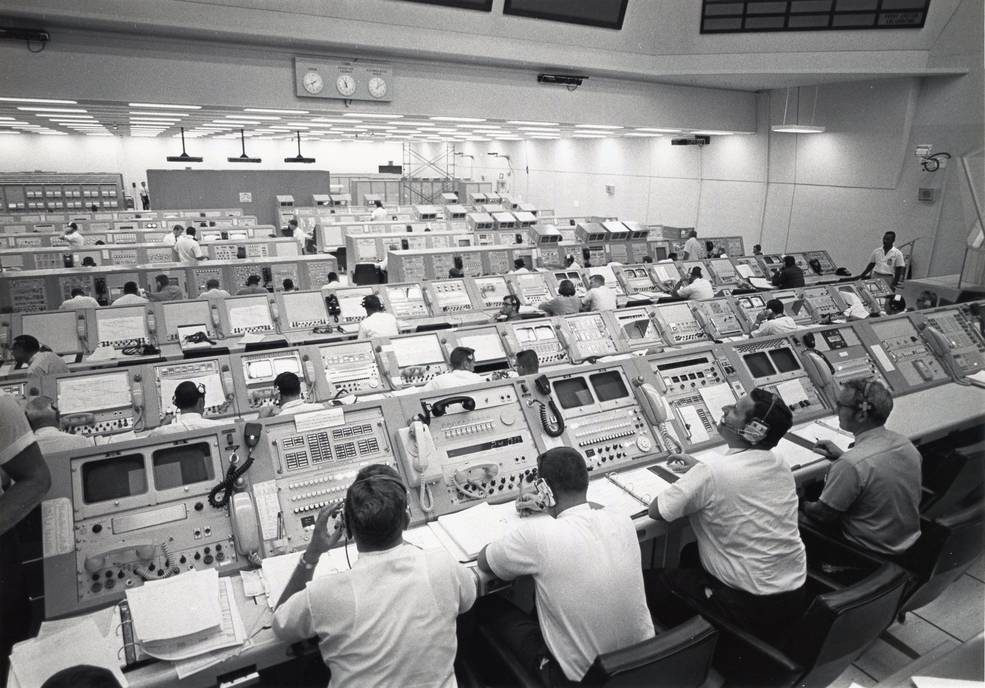
Distributed observation, finite human attention. NASA, 1969,
KSC-69P-3253. Not the source of this alert example.
Image credit.
Notify when the expected loss avoided by informing the recipient
exceeds the communication and attention cost.
Consequence
What harm can still be prevented?
Recipient knowledge
Does this person already know?
Opportunity
Can they act in time, with useful authority?
Low model confidence alone does not answer these questions.
Neither does a fixed alert threshold.
Two forms of reliance
Compliance
Responding when automation signals a problem. Measure
unnecessary action on false alerts.
Reliance
Depending on silence. Measure harmful misses when the system
does not alert.
Supervisory capacity
Depends on neglect tolerance and intervention time. Bursts,
context switching and simultaneous exceptions defeat simple
averages.
Track the queue, not just the classifierPrevalencePPVResponse timeSentinel-found missesDownstream harm
Tambe (1997), STEAM communication; Bliss et al. (1995); Meyer (2001,
2004); Lee & See (2004); Crandall et al. (2005). Human-factors
findings need contextual transfer to LLM systems.
Artificial OrganizationsAuthority & risk / 16
Recognition does not imply approval
What counts as an act?
What is allowed is a separate question.
Observed eventActor submits a signed record
constitutive question
Does this count as an official act?
Check actor capacity, context, required form and the applicable
institutional rule.
regulative question
Was the act permitted, required or prohibited?
Check scope, conditions, exceptions and the rule's authority. An
effective act may still be forbidden.
Regimentation
Prevent a prohibited transition at a boundary the
system actually controls. A guard cannot retroactively undo an
external effect.
Enforcement
Detect and respond to a violation. Record,
notify, sanction or repair where legitimate. A violation log is
not prevention.
A directed commitment
DebtorWho owes?
Content + conditionWhat performance, when?
CreditorTo whom?
A message can help create a commitment; it is not a complete
lifecycle specification. Preserve the undertaking independently of
the conversation.
Transition
Meaning to retain
Question at the boundary
Create / activate
An undertaking is established or its condition becomes true.
Which parties, terms and authority made it valid?
Satisfy / discharge
The required performance is settled under its criterion.
Which evidence establishes satisfaction?
Cancel / release
Stopping and a creditor's release are different acts.
Who may do it? Do notification or compensation duties remain?
Violate / repair
A requirement was not met; a response may now be owed.
What remedy is authorized, feasible and independently checked?
Conflicting rules need more than recency
Priority, specificity, time and authority can matter, but “newest
wins” is not valid when a junior actor cannot supersede the
governing rule. Make disagreements inspectable; do not hide them
inside a prompt.
Jones & Sergot; Grossi and colleagues; Singh; Yolum & Singh;
BOID, OMNI and electronic-institution research. Legal heuristics
remain jurisdiction- and rule-dependent.
Artificial OrganizationsEvidence & judgment / 17
Do not collapse the records
Finished. Accepted. Effective?
A stopped run, a reviewed submission, and a successful outcome are
three different observations.
01 / Commitment
The duty is accepted
Record debtor, creditor, scope, deadline and criterion.
02 / Execution attempt
Work is attempted
Record actor, authority, input, progress and effects.
03 / Submission
A result is offered
Preserve the artifact and its evidence packet.
04 / Acceptance
A defined check is met
A designated reviewer applies the criterion.
05 / Observed outcome
Consequences are measured
Over a stated horizon, effects may confirm success, reveal harm or
remain unknown.
These are distinct records, not an unconditional progression. Review
can require rework; an accepted submission can still have adverse
downstream effects.
Silence has states
Checked, fresh, within limitsPositive health evidence
Checked, uncertain or degradedResult exists; adequacy is unresolved
Not checked / check failedAbsence of evidence is visible
Evidence stale / not applicableTime and scope constrain interpretation
What is still in flight?
An empty queue can coexist with active producers, consumed but
unfinished tasks, delayed messages, or lost work.
Completion detection must account for producers,
attempts, expected results and recovery, not only the absence of a
matching tuple.
A good rationale is a witness statement. It does not replace an
action trace or independent acceptance evidence.
GitLab / public incident
Service restored and
all changes recovered are different claims.
Recovery ownership, artifact dependencies, service checks and
observed data loss belong in different records.
Book synthesis, Chapters 9 and 14; GitLab's 2017 postmortem; W3C PROV;
source and uncertainty traditions. The five-record separation is an
operational design synthesis, not a universal standard.
Artificial OrganizationsEvidence & judgment / 18
A source link is the beginning of review
Preserve the path from evidence to claim.
LINEAGE
Where did it come from?
PROV: entities, activities, agents, derivations and attribution.
Recorded history does not prove truth or permission.
INFERENCE
Why does it follow?
Toulmin: data support a claim through a warrant; backing supports
the warrant; qualifiers and rebuttals bound it.
JUDGMENT
How much support, and for what?
Represent uncertainty, source quality, task-specific reputation
and competing explanations separately.
DataObservation or source
because of the warrant
ClaimBounded conclusion
Backing: why the inference is credibleQualifier: how far the claim reachesRebuttal: what could defeat it
Ignorance ≠ disbelief
bbeliefddisbeliefuuncertainty
b + d + u = 1 projected probability = b + a·u
In a binomial subjective opinion, a is the base rate.
Complete uncertainty (u = 1) differs from complete disbelief (d =
1), even though both have b = 0.
Practical equivalent: “not checked” and “checked
and invalid” must remain distinguishable even without numerical
calculus.
Reputation has a task
Accurate extraction does not establish sound legal judgment,
honest reporting or permission to act.
Which activity and conditions?Whose experience or social evidence?How much, how recent, how independent?What would reverse the judgment?
A global trust score can erase the very distinction needed for
delegation.
This schematic illustrates ACH reasoning, not a scored dataset. A
fits-everything observation discriminates little. Assess quality and
dependence before counting inconsistencies.
W3C PROV (2013); Toulmin (1958); Jøsang (2001, 2016); Sabater &
Sierra (2001, 2005); Heuer (1999). Calibration compares numerical
forecasts with observed frequencies, not rhetorical confidence.
Artificial OrganizationsEvidence & judgment / 19
Preserve reasons that can change a decision
Agreement is cheap. Independence is not.
A role called “critic” is not evidence of independent judgment.
Attacks, not support arrows
Arguments a–f; inspected Tweety graph.
Set notation: attacks R; grounded set G (green).
R = {(a,b),(b,c),(c,d),(d,e),(b,f),(e,f)}
G = {a,c,e}
Semantics
Specify which sets of arguments count as acceptable.
Skeptical asks about all relevant extensions;
credulous asks about at least one.
Values
A defeat can depend on an audience's priorities. Make those
priorities explicit; a formal solver cannot authorize the
organization's values.
Truth
Acceptance in a graph does not prove a premise. Keep sources,
warrants, uncertainty and independent checks outside mere voting.
What makes dissent useful?
Contrary evidence
Preserve the observation or argument, not just a theatrical
opposing persona.
Authentic versus assigned
Human studies distinguish genuine minority positions from
assigned advocacy; transfer requires testing.
Consequential criticism
Can an objection change the decision, halt an act, or require an
additional check?
Three agreement traps
Sycophancy
Agreement with a user's belief can be rewarded even when
misleading.
Evaluator self-preference
A judge may favor outputs resembling its own. A second voice is
not automatically a second standard.
Shared errors
Common data, scaffolds and assumptions can correlate failures.
Different names or model families prove little.
Close with a recordQuestionOptionsCriteriaEvidenceDissentOwnerReview trigger
Dung (1995); Bench-Capon (2003); Nemeth, Brown & Rogers (2001);
Sharma et al. (2023); Panickssery et al. (2024). Diagram's accepted
set is formal status, not a reliability claim about real-world facts.
Artificial OrganizationsEvidence & judgment / 20
Retrieve what governs, not just what resembles
Validity before similarity.
AuthorityWho can establish this rule?
ScopeWhere does it apply?
Effective timeWhen did it govern?
SimilarityWhich eligible record is relevant?
This is the book's recordkeeping rule, not a theorem about every
retrieval system. A high retrieval score cannot establish that a rule
governed an act.
Illustrative history
Two clocks, two questions
MondayTuesdayWednesdayThursday
Effective ruleNew policy applies from Monday
Local recordEarlier version still heldUpdate received
What should have governed? Consult effective time.
What did the actor know? Consult recorded
information at the action time. Preserve both histories; do not
rewrite the past.
Organizational knowledge persists in people, routines, culture,
structures, settings and external archives.
Transactive memory is knowing who knows what. An
expertise directory and a document search answer different
questions.
These retention locations are not administrative levels such as
individual, department and company.
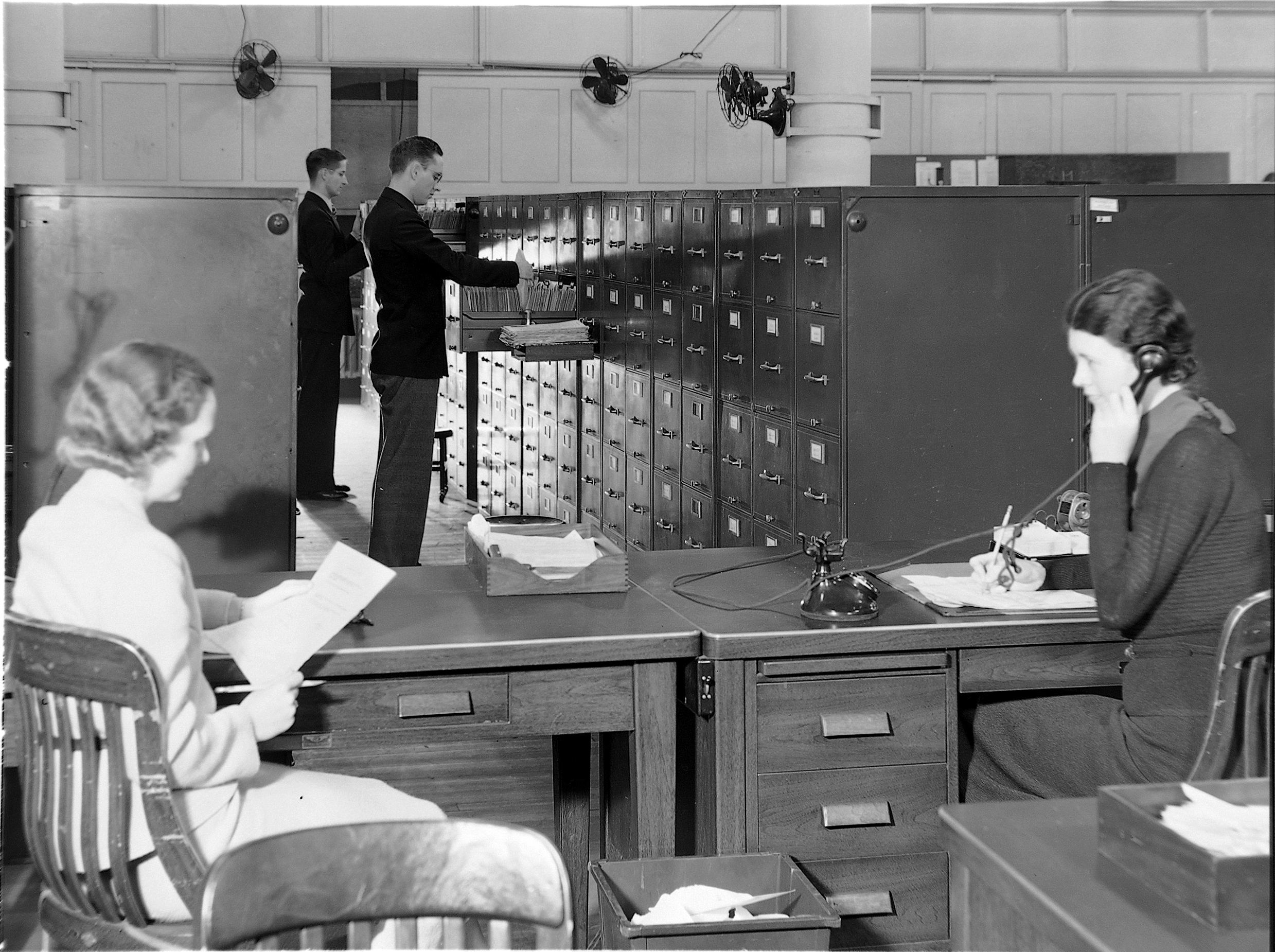
Files, people, routines. TVA central files, 1936; not evidence of
policy validity. TVA Web Team,
CC BY 2.0, unchanged.
Source & credit.
Append facts; revise judgments
An immutable observation can remain recorded while its
interpretation changes. Current policy, available budget and final
acceptance can depend on newly received facts.
CALM: monotonic semantics relate to
coordination-free distributed consistency under assumptions. This
does not remove communication or agreement from every decision.
PredictionObserved resultDiagnosisAuthorized changeNew test
Walsh & Ungson (1991); Wegner (1987); MacLean et al. (1991);
Hellerstein & Alvaro (2019). The two-clock example is
illustrative, not a legal determination.
Artificial OrganizationsEvidence & judgment / 21
Content · communicative act · consequence
A message can ask. It cannot prove.
Keep the request, undertaking, reported result and accepted outcome
distinct.
ask-one requests one answer; ?price is
the query variable. Language declares syntax; ontology declares
vocabulary. Neither guarantees shared interpretation or permits a
trade.
Finin et al. (1994), §3; original query, whitespace normalized.
Inspected, not executed.
Speech acts / saying can be doing
Separate content (what is said), force (the communicative act),
and effect (what happens).
Request
“Please send the report.”
Promise
“I undertake to send it.”
Inform
“I sent the report.”
Editorial examples: a request is not an accepted duty; a promise
is not performance; an assertion is not verified evidence.
FIPA-ACL likewise distinguishes request,
agree, refuse, inform and
failure. KQML is not a FIPA product.
01
Request
The sender asks for an act.
02
Undertaking
Valid terms establish who owes what.
03
Report
The actor says what it did.
04
Acceptance
Evidence meets the stated criterion.
A reading sequence, not a universal wire protocol: refusals, failures,
cancellation and disputed evidence require their own transitions.
MCP / tools and context
Structured calls and results connect a client to a server. A
successful response can still be irrelevant, inaccurate or outside
the institutional permission for an act.
A2A / agents and tasks
Discovery, messages, tasks and artifacts support interaction
across exposed agents. Advertised capability and completed
protocol state do not establish competence or accepted business
value.
What survives the conversation?
Retain parties, scope, conditions, rule version, message identity,
supporting evidence and the disposition of the commitment. A
transcript cannot substitute for an explicit lifecycle.
Cancellation is another act. Ending an exchange need not
release a commitment, stop a worker or reverse an effect. Record what
remains owed and who must notify, compensate or recover.
Finin et al. (1994), KQML §3; FIPA ACL (2002); Singh (1999); Yolum
& Singh (2002); MCP 2025; A2A 1.0 (2026). Full references and
source boundaries: book §§8.6 and 12.6.
Artificial OrganizationsOrganizing work / 22
The protocol carries it; the institution governs it
Conceptual responsibility boundaries, not a mandatory product stack.
A2A 1.0 leaves in-task authorization scope, validity and revocation to
implementations. Version the protocol you actually use.
ReAct
Reasoning with actions and observations; not institutional
authority or independent acceptance.
Reflexion
Feedback across attempts; not proof that feedback is correct or
outcomes improve.
AutoGen
Programmable agent interaction; round-robin speaking is not
capability-based allocation.
MetaGPT
Role-oriented processes and artifacts; role names alone do not
enforce duties.
Magentic-One
Orchestration, progress tracking and replanning; not continuity of
obligations or authority after plan changes.
Generative Agents
Memory, reflection and planning in simulation; believable behavior
is not institutional readiness.
Keep durable state outside context
Record actor, policy, revision, operation identity, attempt and
evidence. Context can be replaced; institutional records must
remain inspectable.
Bind control to the real effect
A well-formed request can still be unauthorized. Check admission,
stale authority, idempotency and uncertain-effect recovery where
they can be enforced.
Chapters 12 and 15: Finin et al. (1994); FIPA ACL (2002); Singh; MCP
2025; A2A 1.0 (2026); Yao et al.; Shinn et al.; Wu et al.; Hong et
al.; Fourney et al.; Park et al. This is a mechanism comparison, not a
current-product ranking.
Artificial OrganizationsOrganizing work / 23
One governed outcome before a whole company
Build the complete loop. Then widen it.
DEFINE
Outcome. Name the result and how it will be observed.
Baseline. Try a capable single worker or deterministic
process.
Acceptance. Define the check and who applies it.
BIND
Responsibility. Specify roles, duties and enactment.
Authority. Scope data, actions, budgets and expiry.
Coordination. Match dependencies to the smallest
sufficient mechanism.
Evidence. Preserve observations, reasons and revisions.
EXERCISE
Failure. Interrupt, duplicate, delay and revoke in
isolation.
Review. Distinguish submission, acceptance and observed
outcome.
Expand. Increase scope only when representative results
justify it.
Condensed editorial construction sequence from Chapters 13-14. A
passing local test does not prove open-ended autonomy.
Exercise the boundaries before expanding
Isolated test
Required observation
Submit the same operation twice
The effect is not duplicated; the record explains the repeated
request.
Revoke authority during work
The consequential boundary rejects stale authority before the
effect.
Stop after effect, before acknowledgment
Recovery checks what happened before deciding whether to repeat.
Replace the worker
Unfinished duties, evidence and scoped access survive the change
of actor.
Submit persuasive but inadequate evidence
The acceptance check rejects the claim without treating fluent
explanation as proof.
Proposed construction checks, not results of a new experiment. Use
isolated fixtures; do not create failures in a live organization to
fill this table.
An inspectable result
Keep the initial state, actor and authority, attempted operation,
observed effect, evidence, reviewer decision and known limitation.
Retain enough detail to reproduce the check.
A bounded next step
Increase one dimension deliberately: task variety, concurrency,
resources or autonomy. Keep a stopping rule and a way to contain
failures while collecting representative evidence.
Editorial construction sequence and proposed checks: book Chapters
13–14, drawing on the coordination, authority, evidence and recovery
literature. The next sheet distinguishes the historical cases from
these design responses.
Artificial OrganizationsEvidence & judgment / 24
Start with the finding, then inspect its support
Six situations. Different evidence.
The case tells you which distinction matters, not which product to
buy.
Public incident
Mars Climate Orbiter
Insight. Division of labor must transfer verification
duties and shared unit meaning along with the data.
Transfer: verify semantics at handoff. Passing a physical
test does not validate navigation data.
Public decision
Air Canada
Insight. Misleading chatbot advice left a customer loss to
remedy, not merely a statement to correct.
Transfer: verify the official rule and authority behind a
promise. Fluent answers do not settle accountability.
Public incident
Knight Capital
Insight. Automation executed orders and emitted errors
without effective controls over the exposure it created.
Transfer: test admission, monitoring and containment. Good
output elsewhere does not excuse an unguarded action.
Public incident
GitLab recovery
Insight. Restoring service did not restore every database
change, so availability and recovered data were distinct outcomes.
Transfer: separate availability from data completeness and
describe observed loss.
Research family
Collective judgment
Insight. Sycophancy and evaluator self-preference can
produce favorable judgments without independent confirmation.
Transfer: preserve contrary reasons and specify closure. A
majority is not independent corroboration.
Local library specimen
Rinda work claiming
Insight. Taking one tuple excludes a second taker of that
tuple but does not prevent duplicate publication or prove
completion.
Transfer: distinguish local atomicity from durable
ownership, recovery and acceptance.
One result; several non-substitutable checksIntelligible handoffAuthorized actCompleted attemptAccepted resultObserved consequence
Test a proposed remedy. Reconstruct the failure conditions,
introduce one control and retain a capable baseline. Observe whether
the damaging effect is prevented, detected or merely reported sooner;
these are different achievements.
NASA/JPL (1999); Moffatt v. Air Canada (2024); SEC Knight Capital
order (2013); GitLab postmortem (2017); Sharma et al. (2023);
Panickssery et al. (2024); local Rinda harness. Exact source records
and interpretation: book Chapters 2 and 14.
Artificial OrganizationsOrganizing work / 25
For the next task, experiment or review
Test the distinction.
BEFORE DISPATCH
Whose act is this?
Outcome → responsible role → current actor → authority →
acceptance criterion.
Claim: what is asserted? Observation: what was
checked, when and under which conditions? Gap: what remains
uncertain? Next act: who may resolve it and which evidence
would close it?
A missing observation is an open question, not a green status. A
known defect needs an owner and disposition, not repeated escalation
without an available action.
Four open research demands
Governable specifications: can conversational authoring
preserve unambiguous duties and revision rules?
Affordable oversight: what review burden and miss cost appear
under realistic bursts? Institutional memory: can
stale-but-similar records be rejected without losing useful
precedent? Long-horizon reliability: does performance survive
interruptions, changed conditions and external effects?
The literature does not establish reliable open-ended company
autonomy, universal supervision capacity, or one best memory
architecture. State what evidence would disconfirm your preferred
approach.
When rules change. Record the approver, effective time,
affected cases and migration or rollback plan. An agent's proposed
improvement does not alter active obligations until the authorized
revision takes effect.
Artificial OrganizationsEvidence & judgment / 26
A field guide is a route into the evidence
Return to the source.
A compact statement is useful only while its assumptions remain
visible.
References & return routes
Primary companion source:Artificial Organizations: A Study Monograph, v1.3, research through 20 September 2026. Curated and written by
AI under the direction of Dr. Paulo Salem. Every sheet's footer
points to the relevant chapters and final PDF pages.
Organization: Simon,
Administrative Behavior (1947); Coase, “The Nature of
the Firm” (1937); Garicano, “Hierarchies and the Organization of
Knowledge in Production” (2000).
Coordination: Smith, “The Contract Net Protocol” (1980);
Gelernter, “Generative Communication in Linda” (1985); Hoare,
“Communicating Sequential Processes” (1978).
Authority: Parasuraman et al., “A Model for Types and
Levels of Human Interaction with Automation” (2000); Burrows,
“The Chubby Lock Service” (2006).
Evidence: W3C, PROV-O (2013); Toulmin,
The Uses of Argument (1958); Heuer,
Psychology of Intelligence Analysis (1999).
Decision: Dung, “On the Acceptability of Arguments…”
(1995); MacLean et al., “Questions, Options, and Criteria”
(1991).
Formal result: preserve the assumptions.
Observed case: separate fact from proposed response.
Benchmark: inspect the task and baseline.
Vendor account: retain attribution.
Editorial diagram: use it to understand a relation, not to
estimate an effect.
Companion to Artificial Organizations: A Study Monograph, working
edition 1.3. Curated and written by AI under the direction of Dr.
Paulo Salem. Published 1.2 remains a separate frozen release.